If you’ve ever returned to your motorhome after a long drive and found the leisure battery sitting at 60% instead of the 95% you expected, you’re not alone. Modern vehicles and modern batteries simply don’t talk to each other the way they used to and the gap between them is where a good DC-DC charger for motorhomes earns its keep.
This guide walks you through everything a UK motorhome, caravan or campervan owner needs to know in 2026: why split-charge relays are no longer enough, how smart alternators changed the rules, what to look for in a modern charger, and how to size and install one that actually fits your build.
What Is a DC-DC Charger and Why Do You Need One?
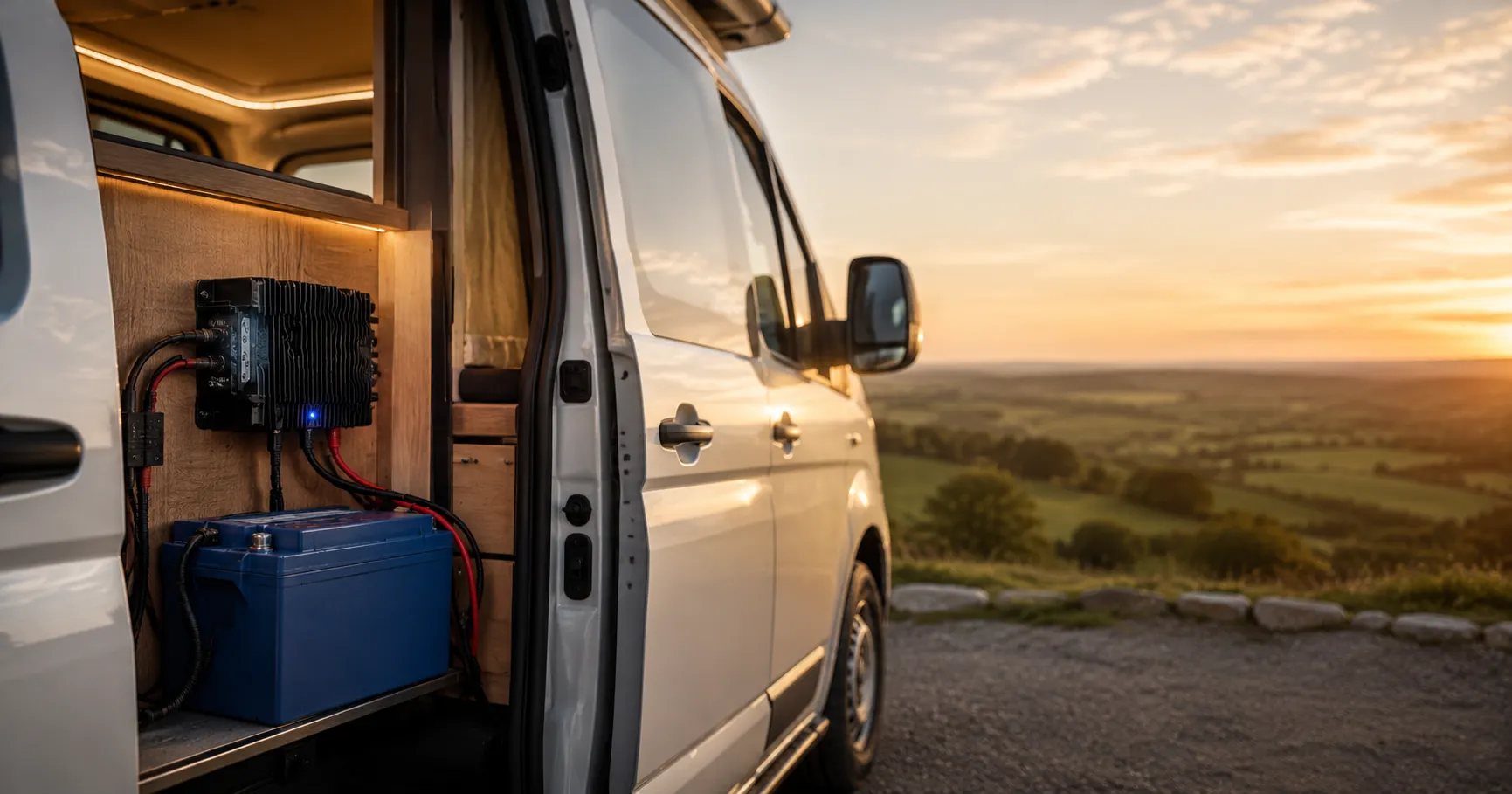
A DC-DC charger, also called a battery-to-battery (B2B) charger, sits between your vehicle’s starter battery and your leisure battery bank. Its job is straightforward: it takes the variable voltage from your alternator, conditions it into a clean multi-stage charging profile, and delivers the result safely to your auxiliary batteries.
So instead of hoping the alternator does the right thing for your lithium pack, the DC-DC charger guarantees it. It limits the current to a safe level. It boosts low voltages up to your battery’s correct absorption voltage. And it isolates the leisure bank when the engine stops, so you never accidentally drain the starter battery.
Two Big Changes Made DC-DC Chargers Essential
For decades, motorhomes ran on a simple voltage-sensing relay: when the engine started, and the voltage rose, the relay closed and connected the two batteries in parallel. Simple, cheap, effective. So why have these relays become a problem?
1. Smart Alternators (Euro 5 and Euro 6 Vehicles)
Any vehicle registered from roughly 2015 onwards uses a “smart” or “regenerative” alternator. Instead of producing a constant ~14.4V, the engine management system drops the alternator’s output as soon as the starter battery is full sometimes as low as 12.3V, to save fuel and cut emissions.
Consequently, a voltage-sensing relay sees that lower voltage and either disconnects or trickles a useless dribble of current into your leisure battery. A proper DC-DC charger ignores this completely. It takes whatever the alternator gives it and boosts the output to the correct charging voltage for your battery type. Therefore, you get full, fast charging on every drive not just the first ten minutes.
2. Lithium Leisure Batteries
LiFePO4 batteries have transformed off-grid touring. They’re lighter, hold voltage better, and last three to four times longer than lead-acid. However, they also have very low internal resistance, meaning they will pull every amp an alternator can give them, sometimes far more than the alternator is rated for.
So if you connect a 230Ah lithium leisure battery directly to a 120A alternator through a relay, you risk cooking the alternator, the wiring, or both. A DC-DC charger caps the current at whatever value you set, protecting both ends of the system. Pair the right charger with a quality battery like the Fogstar Seat Base 230Ah, and you’ve got a setup that will outlast the rest of the vehicle.
How to Size a DC-DC Charger for Your Motorhome
Pick the wrong size and you’ll either limp-charge for hours or stress your alternator. The right size sits in the sweet spot between your alternator’s output and your leisure battery’s capacity.
Use these three rules:
- Rule 1 — Alternator capacity. Never pull more than 50% of your alternator’s rated output through the charger. If you have a 120A alternator, cap the DC-DC charger at 60A. The rest of the alternator’s capacity is needed for the vehicle’s own electrics.
- Rule 2 — Battery capacity. Match the charger to your leisure bank. As a rough rule, aim for a charge current between 10% and 30% of your bank’s capacity. For a 230Ah lithium bank, that’s a 25–70A charger.
- Rule 3 — Charging time. Divide your usable capacity by the charge current to estimate your recharge time. A 30A unit on a 200Ah bank takes around 6–7 hours of driving to fully recharge from 20%.
For most VW T6, Ford Transit Custom and Mercedes Vito conversions, a 30A unit is the sensible middle ground. For larger builds with bigger banks and longer touring schedules, a 50A or higher charger pays for itself in faster turnaround.
What to Look for in a Modern DC-DC Charger
Not every DC-DC charger is created equal. The cheapest units do nothing more than convert voltage; the best ones manage your entire DC system intelligently. Prioritise the features below when comparing models.
Multi-Stage Charging
A proper charger delivers a five-stage curve: pre-charge, constant current (CC), constant voltage (CV), float, and complete. This sequence is what gives lithium batteries their full 10–15-year service life. Avoid any unit that only offers two- or three-stage charging.
Battery Type Profiles
Look for a charger that supports at least four chemistries: LiFePO4, Li-NCM, AGM and GEL with the correct voltage curve for each. Generic “lithium” presets often charge at too high a voltage and shorten cell life over time.
Programmability and Communication
This is the area where 2026 chargers leap ahead of the older Victron-style units. Newer designs like the Thermo Technica smart DC-DC chargers support RS485 Modbus communication, free Windows configuration software and over-the-air firmware updates. So you can tune every voltage, current and timing setting to your specific battery and even update the firmware as new battery profiles roll out.
Bi-Directional Operation
Standard DC-DC chargers only push power from the starter battery to the leisure bank. However, bi-directional units can reverse direction automatically when needed so if your starter battery goes flat at a remote campsite, the leisure bank can boost it back up without a jump-pack. This is a genuinely useful capability that older fixed-profile chargers simply cannot offer.
Protection Features
At minimum, your charger should have over-voltage, under-voltage, short-circuit and over-temperature protection. Better units add derating curves so the charger steps the current down gradually as it warms up, instead of cutting out completely on a hot day.
Solar Input (MPPT)
Some all-in-one units combine DC-DC charging with an MPPT solar input. These save space and wiring complexity in smaller builds. However, in larger systems, a separate MPPT solar charge controller usually offers better performance and lets you size each input independently.
Installation Essentials
A DC-DC charger is only as good as the wiring it sits in. So before you bolt anything down, work through this checklist:
- Cable size. Use 25mm² minimum for a 30A unit, 35mm² for 50A, and 50mm² for anything above. Undersized cables are the most common cause of voltage drop and poor charging performance.
- Fuses on both ends. Fit a fuse close to the starter battery and another close to the leisure battery. Sized for the charger’s continuous rating plus 25%.
- Mounting location. Bolt the unit to a flat metal surface in a ventilated area, not inside a sealed cabinet next to a fridge compressor. Heat is the enemy of efficiency.
- Engine signal. Most modern chargers need an “engine running” signal (often called D+ or ignition), so they only activate when the vehicle is running. Wire this to a switched ignition circuit, not a constant 12V.
- Grounding. On vehicles, use the chassis as your common negative. On boats and narrowboats, run a dedicated negative cable never use the hull.
Pair the unit with proper battery cables and lugs, the right fuses, and a torque wrench for the terminals, and you’ll have an install that lasts the life of the vehicle.
Frequently Asked Questions
Do I need a DC-DC charger if my vehicle is older than 2015?
Not strictly older alternators produce a steady voltage that a relay can handle. However, if you’ve upgraded to lithium batteries, you still need one to protect the alternator from overcurrent and to deliver the correct charge profile.
Can I run a DC-DC charger and a solar controller at the same time?
Yes, and most builds do. They share the leisure battery and complement each other alternator charging on the move, solar charging when parked. Just make sure both are set to the same voltage targets so they don’t fight each other.
Will a DC-DC charger drain my starter battery overnight?
No. Properly wired units use an ignition signal (D+) and shut down completely when the engine is off. Therefore, there’s no parasitic drain on the starter battery, regardless of how long you park up.
What’s the difference between an isolated and a non-isolated DC-DC charger?
Isolated chargers have separate input and output grounds, which is essential on boats and useful where the chassis grounding is uncertain. Non-isolated units share a common ground via the chassis, which is fine for most motorhomes and campervans and is generally cheaper.
How long should a DC-DC charger last?
A quality unit installed correctly should last 10+ years. Heat, vibration and water ingress are the main killers, so mounting location and cable routing matter as much as the brand on the box.
Choosing the Right DC-DC Charger for Your Build
If you’re upgrading a Euro 5 or Euro 6 motorhome, fitting lithium for the first time, or just tired of arriving on-site with a half-charged leisure battery, a modern DC-DC charger is the single most cost-effective upgrade you can make. It protects your alternator, looks after your batteries, and unlocks the full potential of an off-grid setup.
Browse our full range of DC-DC battery chargers for UK motorhomes, caravans and campervans — including programmable smart units with full RS485 Modbus support, free Windows configuration software, and OTA firmware updates.