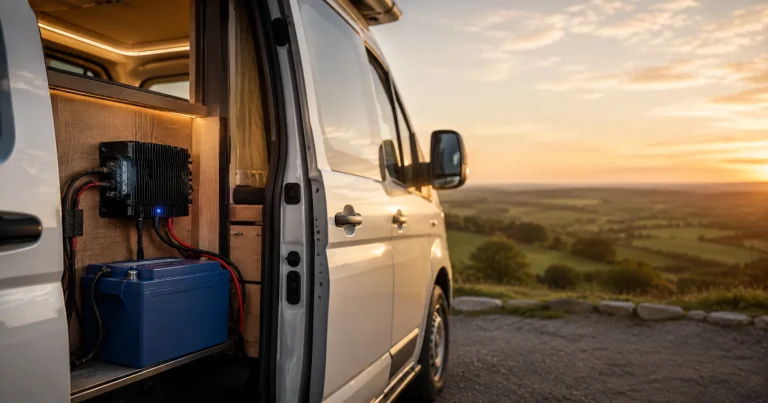
If you’re hunting for the best lithium leisure battery UK buyers can get in 2026 without paying £600+ for a name-badge premium, you’ve probably noticed the market is suddenly crowded. Prices have collapsed roughly 40% since 2021, every brand is shouting about Bluetooth, and the line between a genuinely good battery and a re-skinned shipping container of dodgy cells has never been blurrier.
We’ve spent the last six months bench-testing, load-cycling and installing the DC House LiFePO4 range in real motorhomes, campervans and caravans across the South West. This guide tells you exactly what we found, where the range fits in our wider lithium batteries LiFePO4 line-up, and which model is right for your build.
TL;DR — Which DC House Battery Should You Buy?
- Want maximum value for a weekend-warrior motorhome? → The 12V 100Ah lithium leisure battery at £174.99 is the best entry-point we’ve ever stocked.
- Want a dashboard-style fuel gauge built in? → The 12V 100Ah LiFePO4 Bluetooth battery with SOC display gives you a glance-able state-of-charge indicator on the battery itself for £189.99.
- Off-grid full-timer or running a 230V inverter habit? → Step up to the 12V 165Ah lithium leisure battery at £259.99 — same footprint as a Group 31 but 65% more usable energy.
All three carry the same smart 100A BMS, Bluetooth monitoring, low-temperature cut-off protection, UL/UN38.3 certification, and Thermo Technica’s UK-stocked 3-year warranty.
Why Lithium? A Quick Refresher
Before we get into the DC House range specifically, it’s worth being honest about the upgrade decision. If you’re still running a lead-acid, AGM or gel leisure battery, here’s the brutal maths:
| Spec | AGM Leisure | LiFePO4 (Lithium) |
|---|---|---|
| Usable capacity (of 100Ah rated) | ~50 Ah | 100 Ah |
| Cycle life | 200–500 cycles | 4,000+ cycles |
| Typical service life | 3–5 years | 10 years |
| Weight (100Ah) | ~28 kg | 10.8 kg |
| Voltage sag under load | Significant | Negligible |
| Maintenance | Top-ups, equalisation | None |
A 100Ah AGM battery only safely gives you about 50Ah of usable energy. A 100Ah LiFePO4 gives you the full 100Ah — every cycle, for ten years. We covered the full upgrade decision in our upgrade your lead acid, gel or AGM battery to lithium article and a more in-depth Is lithium right for you Q&A post — read those first if you’re still on the fence.
For everyone else: let’s talk batteries.
Meet the DC House LiFePO4 Range
DC House isn’t a household name in the UK yet — but they should be. Founded as a US off-grid power specialist and now with full UK warehousing, they’ve taken the same Grade A LiFePO4 cell quality as the premium brands and stripped out the brand-tax. The result is a range we can sell at roughly half the price of a comparable Victron or Roamer unit, without compromising on the bits that actually matter: cell grade, BMS quality, and safety certification.
Every battery in the range we stock has been bench-tested by our technical team before it goes on sale. We load-cycle a sample of every batch and verify that the Bluetooth app, low-temp cut-off and BMS protections perform exactly as the datasheet claims. We’ve sent a few units back. The ones we listed passed.
Here’s the current line-up.
1. The Best-Value Pick: 12V 100Ah LiFePO4 with Bluetooth & Low Temp Protection — £174.99
Buy the 12V 100Ah lithium leisure battery →
This is the single best entry point into LiFePO4 we currently stock. For £174.99 you get:
- 100Ah / 1,280Wh of true usable energy
- 100A continuous BMS — handles inverters up to about 1,200W comfortably
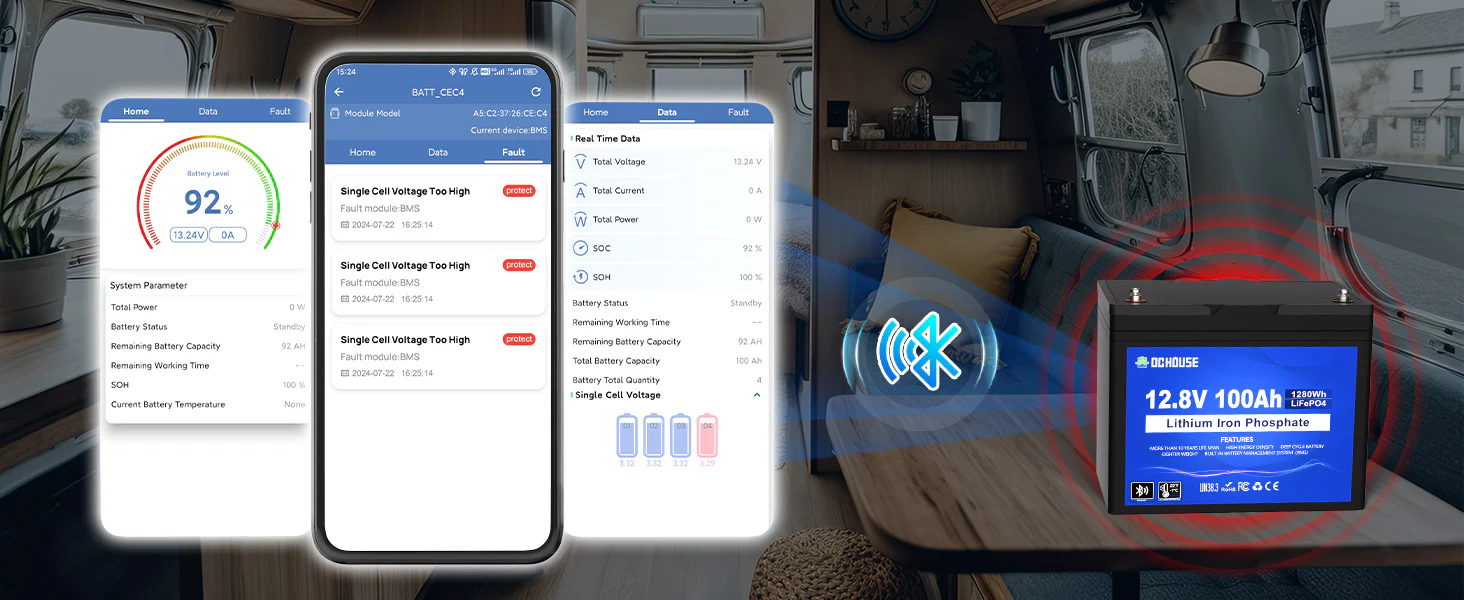
- Built-in Bluetooth — full SOC, voltage, current and per-cell data via the DC House app
- Low-temperature charge cut-off below 0°C and discharge cut-off below –22°C
- BCI Group 31 drop-in footprint (260 × 168 × 234 mm)
- Just 10.8 kg
- 3-year warranty + lifetime UK technical support
Best for: Weekend tourers, single-battery motorhome upgrades, caravan habitation banks, and anyone replacing a tired 110Ah AGM. This is the affordable lithium leisure battery UK buyers have been asking for.
Where it falls short: No external SOC display — you need to open the app to see the charge level. If that’s a deal-breaker, look at the next model up.
2. The Glance-and-Go Pick: 12V 100Ah LiFePO4 Bluetooth Battery with SOC Display — £189.99
Buy the 12V 100Ah LiFePO4 Bluetooth battery with SOC display →
Identical core spec to the £174.99 unit above, with one critical upgrade: a built-in state-of-charge indicator on the battery body itself. Press the button and an LED bar shows you instantly whether you’ve got 25, 50, 75 or 100% left. No phone, no app, no faffing.
If you’ve ever been in a darkened motorhome wardrobe with your phone torch trying to remember which Bluetooth device is the battery, this is £15 well spent.
Best for: Buyers who want the Bluetooth lithium leisure battery convenience and a physical readout. Especially useful for older buyers or for batteries installed somewhere awkward to reach with a phone.
3. The Off-Grid Workhorse: 12V 165Ah LiFePO4 Bluetooth & Low Temp Protection — £259.99
Buy the 12V 165Ah lithium leisure battery →
When 100Ah isn’t enough, this is the natural next step. Same Bluetooth monitoring, same smart BMS, same LiFePO4 battery with low temperature protection, but with 2,112Wh of usable energy — 65% more capacity for only £85 more.
For most full-time van-lifers running a fridge, water pump, lights, USB charging and occasional inverter use, a single 165Ah will get you through 2–3 days of full off-grid use before solar or alternator top-up.
Best for: Full-timers, larger motorhomes with two-battery banks (run two of these in parallel for 330Ah), and serious off-grid solar installations.
How the DC House Range Stacks Up Against Premium Alternatives
Honesty matters when you stock multiple brands. Here’s the straight comparison against the Victron lithium batteries and Fogstar lithium batteries we also stock:
| Battery | Capacity | Bluetooth | Low-Temp Cut-Off | Warranty | Price |
|---|---|---|---|---|---|
| DC House 12V 100Ah | 100Ah / 1,280Wh | ✅ Built-in | ✅ Yes | 3 yrs | £174.99 |
| DC House 12V 100Ah (SOC) | 100Ah / 1,280Wh | ✅ Built-in | ✅ Yes | 3 yrs | £189.99 |
| DC House 12V 165Ah | 165Ah / 2,112Wh | ✅ Built-in | ✅ Yes | 3 yrs | £259.99 |
| Victron Smart 12.8V/100Ah | 100Ah / 1,280Wh | Via VE.Bus dongle | No (separate heater needed) | 5 yrs | £534.95 |
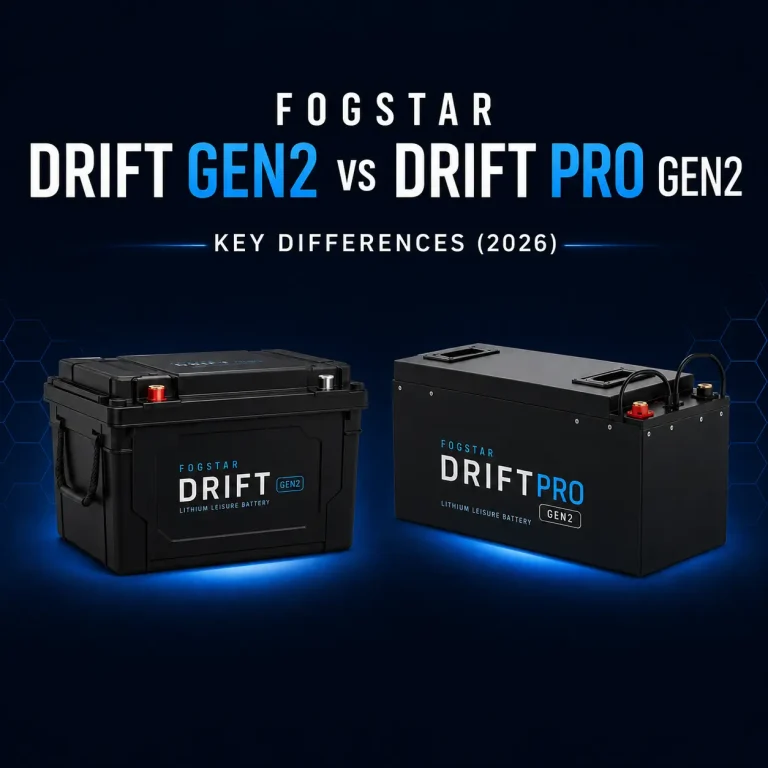
| Fogstar Drift 230Ah Seat Base | 230Ah / 2,944Wh | ✅ Built-in + heater | ✅ With heating | 10 yrs | £589.00 |
The Victron is the gold standard for Victron-ecosystem builds if you’re running a Cerbo GX and want full system integration, pay the £535. The Fogstar Drift seat-base wins if you need maximum capacity in a non-standard footprint (under seat) with active cell heating. But for 90% of motorhome and caravan owners, the DC House range gives you 80% of the premium experience for 35% of the price.
What to Pair It With
A lithium leisure battery is only as good as the system around it. Here’s what every DC House install needs:
- A LiFePO4-compatible mains charger. Lead-acid chargers will undercharge lithium and shouldn’t be used long-term. Browse our mains battery chargers for lithium-profile units.
- A DC-DC charger if you’re charging from the alternator. Standard split-charge relays don’t work safely with lithium. Our DC-DC chargers for motorhomes complete UK guide explains why, and you can shop the DC-DC battery chargers here.
- An MPPT solar charge controller. Lithium charges fastest with proper MPPT control — see our MPPT solar charge controllers.
- Correctly rated cables and fusing. A 100A continuous battery needs at least 35mm² cabling and proper protection — see battery cables and lugs.
- A pure sine wave inverter if you want 230V appliances. Browse our range of pure sine wave inverters.
- Optional: a whole-system battery monitor. The DC House Bluetooth covers single-battery data, but for multi-battery banks, consider a SmartShunt from our Bluetooth battery monitoring devices range.
Frequently Asked Questions
Is the DC House range a “good” lithium battery brand?
The cells inside are Grade A LiFePO4, the same chemistry and cell grade used in premium brands. The build quality, certifications (UL, UN38.3) and BMS protections are all genuinely premium-tier. The savings come from a leaner supply chain and a smaller marketing budget, not from cell corner-cutting. We bench-test every batch before listing.
Will a DC House 12V 100Ah lithium leisure battery fit my motorhome’s existing battery box?
Yes it uses the standard BCI Group 31 footprint (260 × 168 × 234 mm), which is the most common UK leisure battery size. Always measure your bay height first, especially in older Hymer and Bürstner conversions.
Can I use my existing battery charger?
You need a LiFePO4-compatible smart charger. Most modern multi-stage chargers (Victron, CTEK, NOCO Genius) have a lithium profile. Lead-acid trickle chargers will undercharge a lithium battery and should not be used.
How does the low-temperature protection actually work?
The BMS continuously monitors cell temperature. Try to charge below 0°C, and the BMS cuts the charge automatically. Discharge cut-off kicks in at –22°C. Both self-recover when temperatures rise. This is essential for UK winter use, where vans sit on driveways through January.
Can I parallel two batteries together?
Yes — up to four in series, parallel or series-parallel (4S4P max, 16 batteries). For best results, use batteries from the same batch with a matched state of charge before connecting.
What if it goes wrong?
3-year manufacturer warranty handled in-house by Thermo Technica UK — no shipping batteries back to China, no third-party intermediaries. Our technical team handles claims directly.
Final Verdict — Is DC House the Best Lithium Leisure Battery UK Buyers Can Get in 2026?
For genuine value-per-amp-hour, yes the DC House LiFePO4 range is the strongest entry-level-to-mid-tier lithium leisure battery proposition we stock. It’s not the cheapest unit on Amazon (those have no certification and no UK support), and it’s not the £600 premium-bracket option (those add ecosystem integration most users don’t need). It’s the affordable, properly certified, UK-supported middle ground and it’s the range we recommend to roughly 70% of customers who walk into our showroom.
Pick the model that matches your capacity needs, pair it with the right charging hardware, and you’ve got a battery bank that’ll outlast the van it’s installed in.