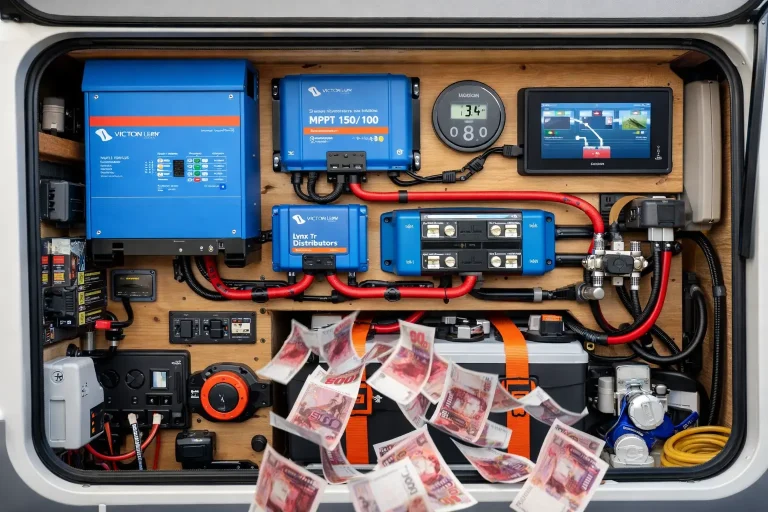
What is an inverter?
An inverter allows you to use mains-powered equipment when your campervan, motorhome, caravan or boat is away from electrical hook-up.
However, choosing the right inverter involves more than selecting the largest wattage.
Your appliances, leisure battery, battery-management system, cables and fuses must all work together.
This FCHAO inverter guide answers the questions customers ask most often. It also explains how to choose between the available 1500W, 2000W, 2500W and 3000W models.
Explore the complete FCHAO pure sine wave inverter range — https://www.thermotechnica.com/brand/fchao/
What does an inverter do?
An inverter converts direct current from a battery into alternating current.
In a 12V leisure system, it converts stored battery energy into 230V mains-style power.
Therefore, it allows you to use suitable household appliances away from electrical hook-up.
An inverter can power equipment such as:
- Laptops
- Phone chargers
- Televisions
- Coffee machines
- Microwaves
- Kettles
- Hairdryers
- Small power tools
- Selected cooking appliances
However, the inverter, battery and wiring must all support the appliance’s electrical demand.
1. What size inverter do I need?
Start by finding the input wattage of the most demanding appliance you want to use.
You can normally find this figure on the appliance rating plate, packaging or instruction manual.
Do not choose an inverter that only just matches the appliance wattage.
Instead, allow some headroom so the inverter does not constantly operate at its maximum output.
| Expected appliance demand | Suggested inverter |
|---|---|
| Up to approximately 1000W | 1500W |
| Up to approximately 1400W | 2000W |
| Up to approximately 1800W | 2500W |
| Up to approximately 2200–2400W | 3000W |
These figures are starting points rather than fixed rules.
Motors, compressors, pumps and some cooking appliances can draw extra power when starting.
Therefore, you must also consider the appliance’s peak or surge demand.
For lighter off-grid use, consider the FCHAO 1500W pure sine wave inverter — https://www.thermotechnica.com/fchao-1500w-12v-pure-sine-wave-inverter-remote-universal-socket/
For more operating capacity, see the FCHAO 2000W pure sine wave inverter — https://www.thermotechnica.com/fchao-2000w-12v-pure-sine-wave-inverter-remote-universal-socket/
More demanding systems may suit the FCHAO 2500W pure sine wave inverter — https://www.thermotechnica.com/fchao-2500w-12v-pure-sine-wave-inverter-remote-universal-socket/
For the highest output in the range, view the FCHAO 3000W pure sine wave inverter — https://www.thermotechnica.com/fchao-3000w-12v-pure-sine-wave-inverter-remote-universal-socket/
2. What appliances can I run from an inverter?
The answer depends on three main factors:
- The appliance’s running wattage
- Its start-up or surge demand
- The capacity of your battery system
Small electronic devices normally place relatively little demand on an inverter.
However, heating and cooking appliances often use considerably more power.
| Appliance | Typical power |
| Phone charger | 5–30W |
| Laptop charger | 45–150W |
| Television | 30–150W |
| Small fridge | 40–150W running |
| Coffee-pod machine | 1000–1500W |
| Microwave | 1200–1800W input |
| Hairdryer | 1000–2200W |
| Travel kettle | 750–1500W |
| Domestic kettle | 2000–3000W |
| Induction hob | 1200–3000W |
| Power tools | 300–2000W |
Always check the appliance’s actual rating plate.
Two appliances that perform the same job can have very different electrical requirements.
You must also consider whether several appliances could operate at the same time.
3. Will an inverter run a microwave?
A correctly specified inverter can run many microwaves.
However, check the microwave’s electrical input rating rather than its advertised cooking output.
For example, an 800W microwave may require 1200W or more from the electrical supply.
The 800W figure usually describes the microwave’s cooking output.
Therefore, check the rating plate and allow enough headroom for start-up demand.
A 1500W inverter may run some lower-powered microwaves.
However, a 2000W or 2500W inverter may provide a more comfortable operating margin.
4. Will an inverter run a kettle?
Yes, provided the inverter and battery system can supply enough power.
However, many domestic kettles use between 2000W and 3000W.
Consequently, kettles rank among the most demanding appliances used in campervans and motorhomes.
A lower-powered travel kettle places less strain on the battery.
It may take longer to boil, but it often suits an off-grid electrical system better.
A 3000W domestic kettle may leave no sensible headroom on a 3000W inverter.
Therefore, consider a lower-powered kettle or heat the water using gas.
5. What is the difference between pure sine wave and modified sine wave?
A pure sine wave inverter produces smooth AC power that closely resembles a household mains supply.
A modified sine wave inverter creates a rougher, stepped electrical waveform.
Although modified sine wave power can operate some basic equipment, it may cause noise, extra heat or unreliable performance.
Pure sine wave output provides a better choice for:
- Laptops
- Televisions
- Audio equipment
- Medical equipment
- Microwave controls
- Battery chargers
- Variable-speed motors
- Modern kitchen appliances
- Sensitive electronic control boards
The FCHAO inverter range uses pure sine wave output.
Compare the available 12V pure sine wave inverters — https://www.thermotechnica.com/product-category/inverters/pure-sine-wave-inverters/
6. How much battery power will an inverter use?
Battery consumption depends mainly on appliance wattage and operating time.
As appliance demand rises, the inverter draws more current from the 12V battery.
A useful approximate calculation is:
Battery current = appliance wattage ÷ battery voltage ÷ inverter efficiency
Typical current demand from a 12V system may look like this:
| AC appliance load | Approximate battery current |
| 500W | 45–50A |
| 1000W | 90–100A |
| 1500W | 135–150A |
| 2000W | 180–200A |
| 2500W | 225–250A |
| 3000W | 270–300A |
These figures are approximate.
Battery voltage, inverter efficiency, cable resistance and appliance behaviour will affect the actual current.
Nevertheless, the table shows why larger inverters need strong batteries and heavy cables.
7. How long will my battery run an inverter?
First, calculate the battery’s nominal energy capacity:
Battery voltage × amp-hours = watt-hours
For example, a 12.8V 100Ah lithium battery contains approximately 1280Wh of nominal energy.
However, the usable AC energy will be lower.
You must allow for inverter losses, battery limits and safe discharge levels.
A 1000W appliance could use most of a 100Ah battery’s available energy in around one hour.
A 2000W appliance could use it much faster.
Therefore, operate kettles, microwaves and hairdryers for relatively short periods.
8. Can I use an FCHAO inverter with a lithium battery?
Yes, you can use a 12V FCHAO inverter with a suitable 12V lithium battery system.
However, check the battery-management system’s continuous discharge-current rating.
A battery may contain enough stored energy but still lack the ability to release it quickly enough.
For example, a 3000W inverter can draw more than 250A at high load.
A battery with a 100A continuous discharge limit cannot support that demand alone.
Check:
- Battery voltage
- Continuous discharge rating
- Peak discharge rating
- Battery-management system limits
- Number of connected batteries
- Cable capacity
- Fuse capacity
- Manufacturer requirements
The complete battery system must support the inverter.
9. Can I use an inverter with a lead-acid leisure battery?
Yes, although lead-acid batteries behave differently from lithium batteries.
Their voltage can fall sharply under a heavy load, especially when partly discharged.
Consequently, the inverter may show a low-voltage warning before the battery appears empty.
Lead-acid batteries also provide less practical usable energy if you want to protect their working life.
Therefore, a high-powered inverter often needs a large lead-acid bank or a suitably rated lithium system.
10. What battery capacity do I need?
There is no single battery capacity that suits every inverter.
The correct capacity depends on appliance load, operating time and maximum discharge current.
As a starting point:
- A 1500W inverter may suit a strong 100Ah lithium battery for short loads.
- A 2000W inverter will often benefit from 200Ah or more.
- A 2500W or 3000W inverter normally needs a substantial battery bank.
- Every battery-management system must support the required current.
These examples are not fixed installation rules.
A 100Ah battery with a 100A BMS cannot provide the full potential of a 1500W inverter.
Equally, a large battery can perform poorly through undersized cables.
Design the system around your appliance use rather than inverter wattage alone.
11. What size cables and fuse do I need?
Cable and fuse sizes depend on:
- Maximum inverter current
- Cable length
- System voltage
- Installation method
- Permitted voltage drop
- Cable temperature rating
- Manufacturer instructions
High-powered 12V inverters draw substantial current.
Therefore, short and correctly sized battery cables are essential.
Undersized cables create voltage drop and heat.
As a result, the inverter may alarm or shut down even when the battery has enough charge.
The fuse primarily protects the cable.
It should sit close to the positive battery connection.
Follow the inverter instructions and use a competent automotive or leisure electrical installer.
12. What does peak or surge power mean?
Continuous output describes the power an inverter can provide during normal use.
Peak or surge output describes the extra power it can provide briefly during start-up.
Equipment containing compressors, pumps, motors or transformers may need much more power while starting.
Common examples include:
- Refrigerators
- Freezers
- Water pumps
- Power tools
- Air-conditioning units
- Some microwave ovens
Therefore, do not choose an inverter using running wattage alone.
13. Can I connect the inverter to my campervan or motorhome sockets?
You can plug a suitable appliance directly into the inverter’s AC socket.
However, connecting an inverter to fixed sockets throughout the vehicle requires careful electrical design.
The installation may need:
- Correct isolation
- Circuit protection
- Residual-current protection
- Appropriate earthing
- Separation from the mains hook-up supply
- A suitable transfer system
Never use a homemade lead to feed inverter power backwards through a vehicle socket or hook-up inlet.
A competent installer should complete or inspect any fixed 230V installation.
14. Why is my inverter alarming or cutting out?
An inverter alarm does not automatically mean the inverter has failed.
Common causes include:
Low battery voltage
The battery voltage may fall below the permitted level during a heavy load.
Undersized cables
Thin or excessively long cables create voltage drop.
Loose connections
Loose terminals and poor crimps restrict current.
They can also generate heat.
Overload
The appliance may exceed the inverter’s continuous or peak capacity.
Battery-management shutdown
A lithium battery may disconnect when the current exceeds its BMS limit.
Excessive temperature
Blocked airflow or sustained heavy use can trigger thermal protection.
Short circuit or appliance fault
The inverter may shut down to protect the system.
Check the displayed fault information, battery voltage and connections before restarting the inverter.
15. Can I leave the inverter switched on all the time?
You can leave an inverter switched on when necessary.
However, it will normally consume some power even when no appliance operates.
This standby draw can gradually discharge the leisure battery.
Therefore, switch the inverter off when you do not need mains power.
The remote controller makes this easier when the inverter sits inside a locker or seat base.
16. How close should the inverter be to the battery?
Install the inverter reasonably close to the leisure battery.
This keeps the high-current 12V cables short and reduces voltage drop.
However, do not install it somewhere unsafe or poorly ventilated.
Follow the battery and inverter manufacturers’ location requirements.
In most installations, it makes sense to keep the battery cables short.
The correctly designed 230V cable can then cover the longer distance.
17. Where should I install an inverter?
Choose a dry, protected and ventilated location.
Suitable positions may include:
- A dedicated electrical compartment
- A suitable seat base
- A ventilated locker
- A protected equipment cabinet
Avoid:
- Wet areas
- Direct heat sources
- Unventilated boxes
- Areas exposed to luggage damage
- Locations with blocked cooling vents
- Incompatible battery compartments
The inverter’s fan and ventilation openings need space to move air.
18. Does an inverter use power when nothing is plugged in?
Yes. An inverter normally consumes a small amount of energy whenever it remains switched on.
Although the draw is lower than an appliance load, it can matter over several days.
For example, an inverter left running during storage can gradually reduce the leisure battery charge.
Switch it off when mains power is not required.
19. Can an FCHAO inverter charge my leisure battery?
No. The FCHAO products covered here are inverters rather than inverter-chargers.
An inverter converts 12V battery power into 230V AC power.
It does not recharge the battery from electrical hook-up.
To charge the leisure battery, you need a suitable charging source, such as:
- A mains battery charger
- A DC-to-DC charger
- A solar charge controller
- A combined inverter-charger
These products perform different jobs within the electrical system.
20. Can I use an inverter with solar panels?
Yes. However, the solar panels do not normally connect directly to the inverter.
A typical system follows this route:
Solar panels → solar controller → leisure battery → inverter → AC appliance
The solar system replenishes energy in the battery.
Meanwhile, the inverter draws energy from the battery when you use a mains appliance.
Solar power can reduce overall battery discharge.
However, a small solar panel cannot instantly replace the energy used by a kettle or microwave.
21. Will a pure sine wave inverter work with sensitive electronics?
Pure sine wave output provides the preferred choice for most sensitive electronic equipment.
It delivers smoother AC power than a modified sine wave inverter.
It particularly suits:
- Laptop power supplies
- Televisions
- Audio equipment
- Medical equipment
- Electronic chargers
- Digital appliance controls
- Variable-speed equipment
Nevertheless, confirm that the appliance voltage, frequency and power requirements match the inverter output.
22. Does the FCHAO inverter include a remote controller?
The FCHAO inverter listings include a remote controller and remote cable.
The controller lets you operate and monitor the inverter without reaching the main unit.
Therefore, you can install the inverter out of sight while keeping the display accessible.
The remote display can provide information such as:
- Battery voltage
- Battery condition
- Power consumption
- Operating status
- Fault information
Browse the complete FCHAO inverter collection with remote displays — https://www.thermotechnica.com/brand/fchao/
23. Why is the last digit flickering on the FCHAO display?
Slight movement in the final digit of the voltage reading is normal.
The control panel measures voltage very sensitively.
Therefore, it detects and displays tiny fluctuations as they happen.
Battery voltage is rarely perfectly static.
It can change slightly as chargers, lights, pumps, fans and other equipment switch on or off.
Because these changes are minor, only the final digit may flicker.
The rest of the display stays static because the main voltage reading remains stable.
This is what you would expect from a sensitive, high-quality control panel.
It displays minor live voltage fluctuations instead of rounding them out or hiding them.
For example, the reading might move between 13.2V and 13.3V while the system remains stable.
However, investigate the system when:
- Several digits change rapidly
- The voltage falls sharply under a small load
- The inverter alarms or cuts out
- Connections become hot
- The display shows a fault
- Appliances behave abnormally
A gently flickering final digit alone does not indicate a fault.
24. How noisy is the inverter cooling fan?
The cooling fan operates when the inverter requires extra cooling.
Its operation depends on temperature, power demand and the inverter’s internal control settings.
During light use, the fan may remain off or operate occasionally.
However, sustained high loads create more heat.
Install the inverter away from a bed if fan noise may become noticeable at night.
Never restrict the airflow to reduce noise.
25. Can I connect an inverter to my vehicle starter battery?
A high-powered inverter should normally run from a properly designed leisure battery system.
Using the starter battery risks leaving the vehicle unable to start.
Starter batteries provide short bursts of cranking current.
They are not designed for repeated deep discharge.
Therefore, use a separate leisure battery system for campervan, caravan and motorhome appliances.
26. Why does my inverter run small appliances but not large ones?
This usually points to a limitation elsewhere in the system.
Possible causes include:
- The appliance exceeds the inverter output
- The appliance has a high start-up demand
- The battery cannot supply enough current
- The lithium BMS reaches its limit
- The battery cables are too small
- The cables are too long
- A connection is loose
- Battery voltage collapses under load
A battery can show a healthy resting voltage but still struggle under a large load.
Therefore, check the voltage at the inverter terminals while the appliance operates.
27. Is a larger inverter always better?
Not necessarily.
A larger inverter provides more potential output.
However, it also needs a battery bank, cables, fuses and connections capable of supporting that output.
Buying a 3000W inverter does not turn a small leisure battery into a 3000W electrical system.
Choose an inverter that comfortably supports your planned appliances.
Then make sure the rest of the installation matches it.
Choosing the right FCHAO inverter
The best model depends on the appliances you want to use and the strength of your battery system.
FCHAO 1500W inverter
The 1500W model provides a practical option for lighter equipment, televisions, chargers and selected lower-powered appliances.
View the 1500W FCHAO inverter with remote control — https://www.thermotechnica.com/fchao-1500w-12v-pure-sine-wave-inverter-remote-universal-socket/
FCHAO 2000W inverter
The 2000W model provides more headroom for medium-powered appliances, tools and cooking equipment.
View the 2000W FCHAO inverter with remote display — https://www.thermotechnica.com/fchao-2000w-12v-pure-sine-wave-inverter-remote-universal-socket/
FCHAO 2500W inverter
The 2500W model suits more demanding systems where a smaller inverter may not provide enough capacity.
View the 2500W FCHAO inverter with universal sockets — https://www.thermotechnica.com/fchao-2500w-12v-pure-sine-wave-inverter-remote-universal-socket/
FCHAO 3000W inverter
The 3000W model provides the highest output in the current range.
However, it requires a correspondingly capable battery bank and electrical installation.
View the 3000W FCHAO inverter for larger off-grid systems — https://www.thermotechnica.com/fchao-3000w-12v-pure-sine-wave-inverter-remote-universal-socket/
Final checks before buying an inverter
Before ordering, confirm:
- The highest appliance input wattage
- Any start-up or surge requirement
- Battery voltage
- Battery capacity
- Maximum battery discharge current
- Battery-management system limit
- Required cable size
- Required fuse and isolation
- Installation location
- Ventilation requirements
- Whether several appliances may run together
- Whether you need direct or fixed-socket operation
A correctly matched system will perform more reliably than one selected using inverter wattage alone.
Explore all motorhome, caravan and campervan inverters — https://www.thermotechnica.com/product-category/inverters/
For clean mains-style power away from hook-up, view the complete FCHAO 12V pure sine wave inverter range — https://www.thermotechnica.com/brand/fchao/